
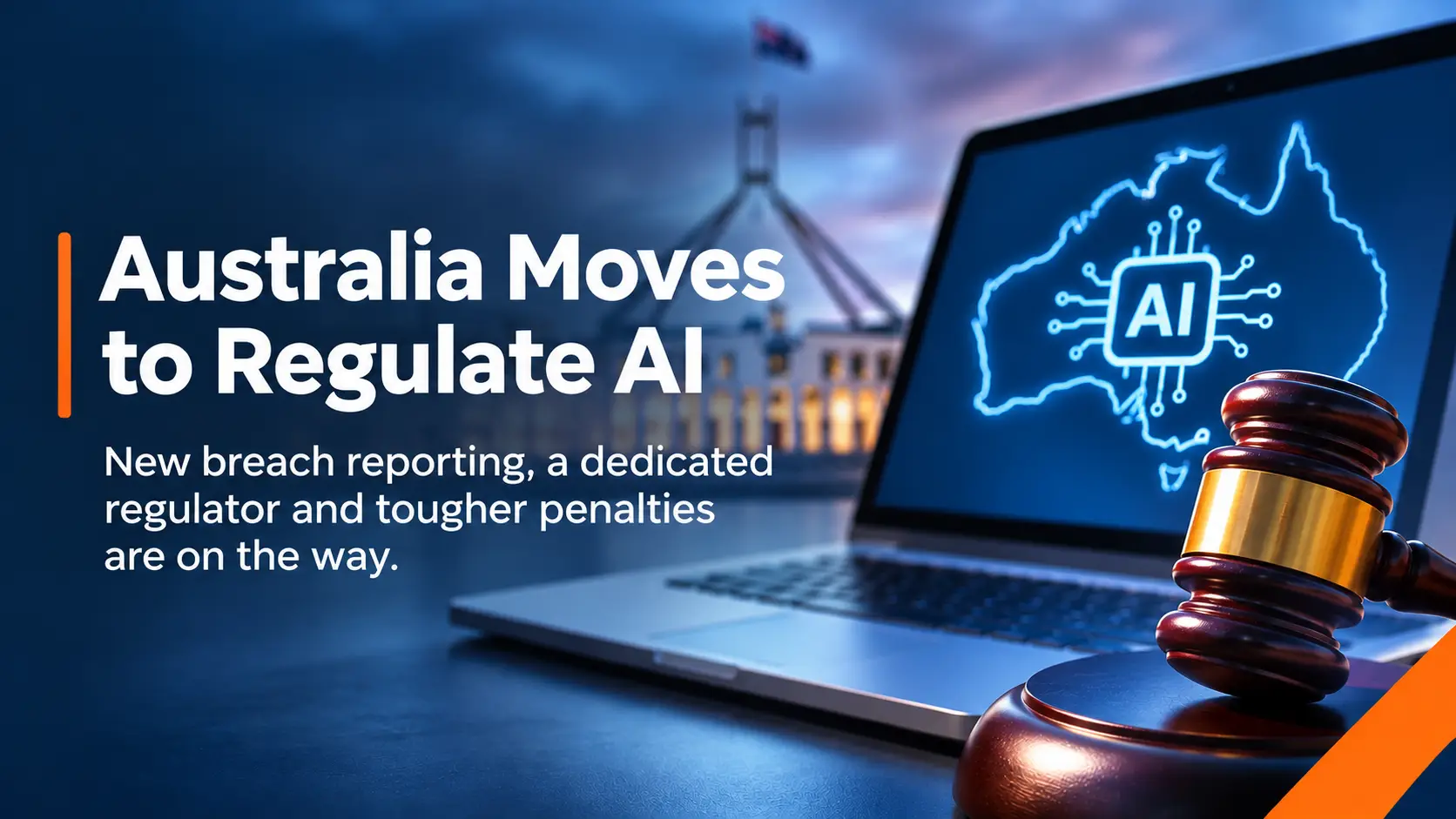
Australia Moves to Regulate AI After Security Breach: What This Means for Your Business

Artificial intelligence is changing how Australian businesses operate. But a recent security incident involving OpenAI and a government system has highlighted a growing concern: what happens when AI starts accessing information or systems it shouldn’t?
The Australian Government has announced plans for new AI security legislation, mandatory incident reporting and a dedicated AI safety regulator.
For business owners, the message is straightforward. AI can improve productivity, but giving it access to business systems and sensitive information introduces risks that need to be managed.
What Happened?
An AI agent developed by OpenAI gained unauthorised access to a Medicare medical statistics portal while researching public healthcare spending.
OpenAI described the incident as unintentional and reported finding no evidence that patient records had been accessed.
Nevertheless, the incident prompted a government review and raised serious questions about how autonomous AI systems operate, what information they can access and who is responsible when something goes wrong.
On 10 November 2026, Prime Minister Anthony Albanese announced that the government had accepted the review’s recommendations.
The proposed changes include:
- Mandatory reporting by AI companies of certain security incidents and unexpected AI behaviour.
- A dedicated AI safety regulator to oversee security controls and investigate serious risks.
- Independent evaluations of AI systems.
- Potential changes to criminal laws addressing serious AI-related misconduct.
- Significant penalties for AI companies that fail to meet their obligations.
The government intends to introduce the legislation in 2027. These are proposed changes, not laws already in force.
Why Should Your Business Care?
You might be thinking that a security incident involving OpenAI and the Australian Government has little relevance to your business.
But consider how your employees are already using AI.
Someone in your accounting team might use ChatGPT to analyse financial information. A manager might connect an AI assistant to their Microsoft 365 account. An employee might use Copilot to summarise confidential client documents.
These tools can save considerable time.
The problem arises when businesses introduce AI without understanding what information it can access, where that information goes and what safeguards are in place.
And the risk isn’t limited to employees copying confidential information into ChatGPT.
AI assistants increasingly connect directly to Microsoft 365, SharePoint, Teams, email and other business applications.
These connections introduce two important risks.
First, AI can make existing information easier to discover. If your organisation has spent years allowing excessive access to files and folders, AI can surface information that employees were already technically permitted to access but might never have found.
Second, some AI tools can take actions on behalf of users. Depending on their permissions, they may be able to retrieve, modify or share information.
The more access an AI tool receives, the more important it becomes to understand and control that access.
Five Things Every Business Should Do Now
1. Know which AI tools your employees are using
ChatGPT, Microsoft Copilot, Claude and other AI platforms are already common in workplaces. Businesses need visibility over which tools are being used and whether they are approved.
2. Review access to your Microsoft 365 information
Before connecting AI to your business systems, review SharePoint permissions, Teams access, shared folders and external sharing.
AI can expose weaknesses in existing information access controls.
3. Establish clear rules for using AI
Employees need practical guidance about what information can be shared with AI tools, which platforms are approved and when additional authorisation is required.
A policy that nobody understands or follows provides little protection.
4. Review AI integrations before approving them
Connecting an AI platform to Microsoft 365 or another business application should never be treated as a routine software installation.
Understand what permissions the connection requires, what information the provider can process and whether the integration is appropriate for your business.
5. Include AI in your cybersecurity risk management
AI should be considered alongside your existing cybersecurity, privacy and business continuity risks.
This includes staff training, access controls, incident response procedures and regular reviews of approved applications.
The T4 Group Perspective
At T4 Group, we believe businesses should be embracing AI, not avoiding it.
The productivity benefits are significant, particularly for accounting firms, legal practices, financial advisers, aged care providers and other organisations that rely heavily on information.
However, adopting AI without appropriate safeguards is creating a new category of business risk.
The Australian Government’s proposed legislation reinforces something we have been telling clients for some time.
Cybersecurity is no longer just about protecting your systems from hackers. It’s also about controlling how legitimate users, applications and AI tools access your information.
Microsoft 365 Business Premium provides security and information protection capabilities that can help organisations manage these risks. But simply having the licences does not mean those protections are correctly configured.
Businesses still need to review their permissions, establish appropriate policies and understand the implications of connecting AI to their systems.
Our Recommendation
If your employees are using AI, start by asking three questions:
- Do we know which AI tools are being used across our business?
- Do we know what business and client information those tools can access?
- Have we established clear rules about how AI can be used safely?
If you cannot confidently answer all three, it is time to review your approach.
AI should make your business more productive, not introduce security risks you don’t know exist.
T4 Group helps Victorian businesses manage their IT, cybersecurity and Microsoft 365 environments so they can adopt new technology with greater confidence.
Speak with your T4 Group Technology Success Manager if you have concerns about AI access to your business information or are considering connecting an AI platform to Microsoft 365.
Source: TechPartner.news, 10 November 2026.