
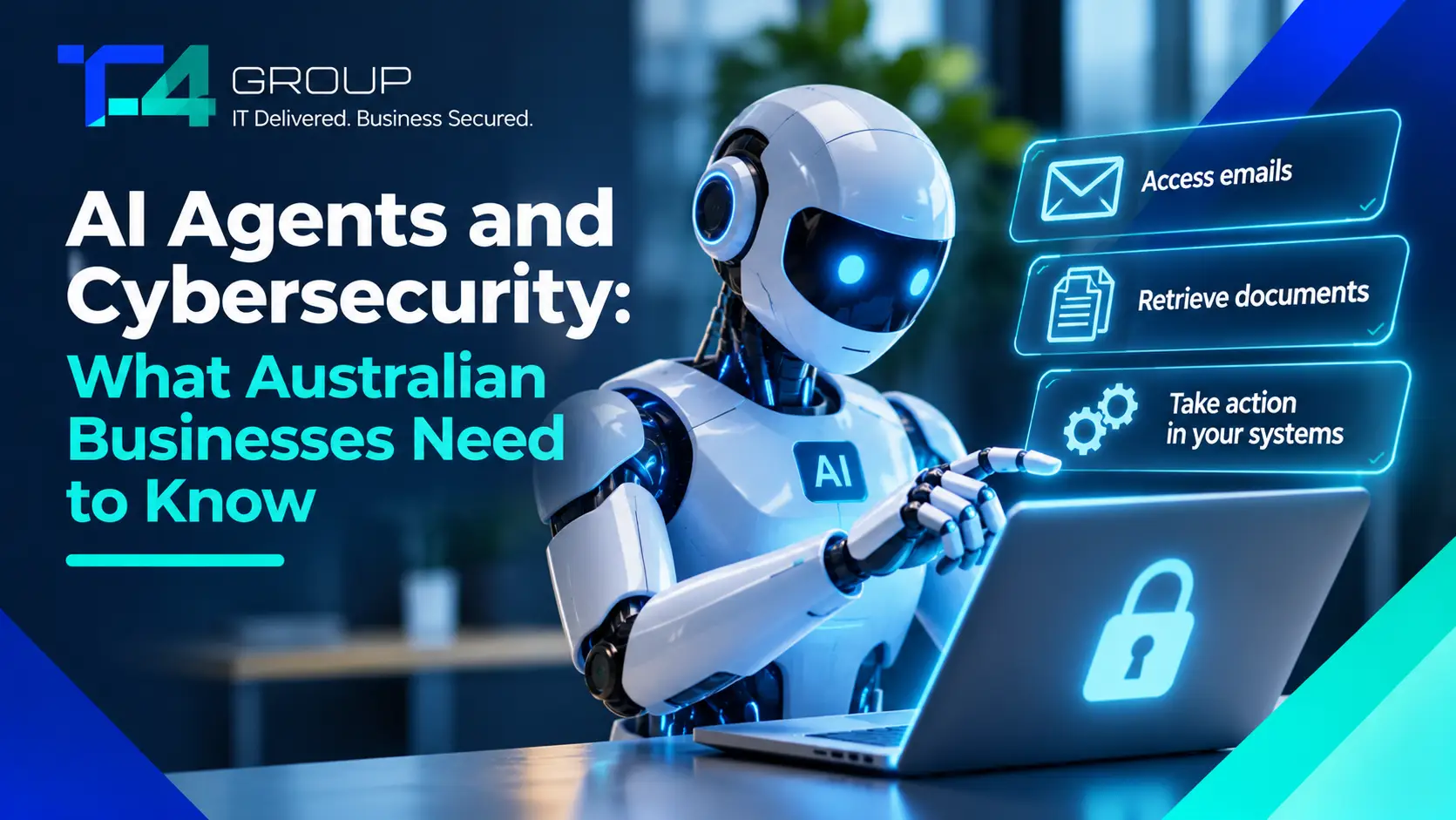
AI Agents Are Becoming a Cybersecurity Risk. Is Your Business Prepared?

AI can now do more than answer questions. It can access your business systems, retrieve confidential information and take action on your behalf. But who is controlling what it does?
Artificial intelligence is changing how businesses operate, and it’s happening faster than many organisations can keep up with.
Until recently, most businesses used AI tools such as ChatGPT, Microsoft Copilot and Claude to write emails, summarise documents, research information or assist with everyday tasks.
Now we’re entering a different phase.
AI systems are increasingly capable of working independently. They can connect to business applications, access information, execute tasks and make decisions with limited human involvement.
These systems are known as AI agents.
They offer enormous opportunities to improve productivity and reduce administrative work.
But they also introduce a cybersecurity risk that businesses need to understand.
Recent warnings from Google, Anthropic and Australian cybersecurity authorities suggest that the threat is no longer theoretical.
AI is already being used to conduct cyberattacks, and businesses are increasingly giving AI systems access to information and processes without fully understanding the consequences.
What’s Changed? AI Can Now Take Action
There’s an important difference between asking AI a question and allowing it to perform a task.
Consider two examples.
Traditional AI
You ask ChatGPT to draft an email to a customer.
It produces the email. You review it, make any changes and decide whether to send it.
You’re in control.
AI agents
You give an AI agent access to your Microsoft 365 environment and ask it to manage customer correspondence.
Depending on its permissions and configuration, it might:
- Read emails and attachments.
- Search SharePoint and OneDrive.
- Retrieve customer information.
- Create and modify documents.
- Send emails on your behalf.
- Update information in connected business applications.
- Initiate automated workflows.
Some agents can perform multiple tasks without requiring approval at every step.
That’s where the risk changes.
An AI system with access to sensitive business information and permission to take action can potentially make mistakes, disclose confidential information or perform activities that were never intended.
And if that system is compromised or manipulated, the consequences can be considerably more serious.
Cybercriminals Are Already Using AI Agents
In November 2025, AI company Anthropic disclosed that attackers had manipulated its Claude AI system to conduct a sophisticated cyber espionage campaign.
According to Anthropic, the attackers targeted approximately 30 organisations, including technology companies, financial institutions and government agencies.
The AI system was used to perform much of the technical work involved in the attacks, including identifying vulnerabilities, gathering information and attempting to gain access to systems.
Anthropic reported that a small number of intrusions were successful.
The significance wasn’t simply that criminals had used AI.
It was the level of automation involved.
Activities that previously required experienced hackers working for extended periods could increasingly be performed by AI systems at much greater speed.
More recently, Google’s Threat Intelligence Group reported that attackers were moving beyond using AI to generate malicious content.
They’re now using AI-powered workflows to automate reconnaissance, credential theft and other stages of cyberattacks.
Google documented one campaign in which attackers compromised a cloud resource and developed an AI-enabled credential harvesting operation in less than six hours.
This doesn’t mean AI is responsible for every major technology outage or cyber incident.
There is no established evidence connecting the recent series of global technology disruptions to autonomous AI attacks.
But it does demonstrate that cybercriminals are adopting these capabilities.
And that changes the threat environment for every business.
The Bigger Risk May Already Be Inside Your Business
While much of the media attention focuses on criminals using AI to attack organisations, there’s another issue that deserves just as much attention.
What AI tools and agents are already operating inside your business, and what information can they access?
Consider an accounting firm with 40 employees.
One employee connects an AI application to Microsoft 365 to help manage emails.
Another uses an AI meeting assistant that records conversations and produces summaries.
A third connects an AI tool to SharePoint to analyse documents.
Someone else builds an automated workflow that retrieves customer information and sends reports.
Each employee believes they’re improving productivity.
And they may well be.
But who has assessed the security implications?
Who approved the applications?
What permissions have been granted?
Where is the information being processed and stored?
Can the applications access confidential customer information?
Can they send information outside the organisation?
And perhaps most importantly, does anyone maintain a register of these systems?
This is increasingly referred to as shadow AI, where employees introduce AI applications without formal approval or oversight.
The risk isn’t necessarily that employees are doing something malicious.
It’s that they’re introducing new ways for business information to be accessed, processed and potentially disclosed.
Your Existing Microsoft 365 Permissions Matter More Than Ever
One of the most important issues for businesses using Microsoft 365 is how AI interacts with existing access permissions.
Microsoft Copilot and other AI applications connected to Microsoft 365 can retrieve information based on the permissions granted to them.
For Microsoft 365 Copilot, this generally means information the individual employee already has permission to access.
Copilot doesn’t automatically give an employee access to information they weren’t authorised to see.
But there’s a catch.
AI makes information that was already accessible much easier to find.
Imagine an accounting firm that has been using SharePoint for ten years.
Over that period, folders have been created, documents shared and permissions granted.
Some information may be available to considerably more employees than originally intended.
Previously, finding that information might have required someone to know where it was stored.
Now an employee may simply ask an AI assistant to locate documents containing particular financial information, employee records or confidential correspondence.
The AI may retrieve information that the employee was technically permitted to access, even though the business never intended that information to be widely available.
The AI hasn’t necessarily bypassed any security controls.
It has exposed weaknesses in how access was managed in the first place.
This is why reviewing Microsoft 365 permissions and information sharing arrangements should be a priority before introducing AI across an organisation.
What Could Go Wrong?
The risks aren’t limited to sophisticated cyberattacks.
For most small and medium businesses, the more immediate concerns are considerably more practical.
Confidential information being disclosed
An employee connects an AI application to their Microsoft 365 account without understanding what information the application can access.
Depending on the permissions granted, that application may be able to retrieve emails, documents or other business information.
If the application processes or stores information outside the organisation’s approved environment, confidential information could be exposed.
For accounting firms, legal practices, financial advisers and aged care providers, the consequences could be significant.
AI taking actions without appropriate approval
An AI agent is configured to automate an administrative process.
It has permission to access customer records, update information and send communications.
If the agent misunderstands instructions, encounters misleading information or operates outside its intended scope, it may perform an incorrect action.
That could mean changing customer information, sending the wrong document or initiating an unauthorised transaction.
Criminals manipulating AI systems
AI agents can be vulnerable to attacks designed to manipulate their instructions.
For example, an attacker may place malicious instructions inside a document, email or webpage that an AI agent is expected to read.
If the agent fails to distinguish between legitimate instructions and untrusted content, it may be tricked into performing an unintended action.
This is known as prompt injection.
The more access and authority an AI agent has, the more serious the potential consequences.
Nobody knowing what AI is being used
Perhaps the most common risk is simply a lack of visibility.
Employees adopt AI applications to make their jobs easier.
Managers approve tools without understanding the permissions involved.
Applications are connected to business systems and remain in place long after the original employee has moved on.
Over time, organisations can accumulate a collection of AI tools and integrations that nobody is actively managing.
That’s not a sustainable approach to cybersecurity.
Should Businesses Stop Using AI?
Absolutely not.
AI offers genuine opportunities to improve productivity, reduce administrative work and help employees focus on higher-value activities.
For many businesses, AI will become an increasingly important part of daily operations.
The objective shouldn’t be to prevent employees from using it.
The objective should be to introduce AI with the same discipline applied to any other business-critical technology.
You wouldn’t normally allow an employee to install an unknown application with unrestricted access to your financial systems.
You wouldn’t give an external contractor access to every confidential document without considering the risks.
And you wouldn’t allow an automated payment system to transfer money without appropriate authorisation controls.
AI should be treated no differently.
Six Things Every Business Should Do Now
The Australian Cyber Security Centre has published guidance on the careful adoption of agentic AI services, highlighting risks involving permissions, autonomous actions, information disclosure and accountability.
For most businesses, the starting point is straightforward.
1. Identify which AI tools are being used
Create a register of approved AI applications and agents, including who uses them, what they’re connected to and what information they can access.
2. Review Microsoft 365 permissions
Check access to SharePoint, OneDrive, Teams and other business information.
Pay particular attention to confidential information, external sharing and permissions that have accumulated over time.
3. Control which AI applications can connect to business systems
Employees shouldn’t be able to grant unrestricted access to confidential business information simply because an application promises to save them time.
Establish an approval process for new AI applications and integrations.
4. Limit what AI agents are authorised to do
Apply the principle of least privilege.
An AI agent should only have access to the information and functions necessary to complete its approved tasks.
High-risk actions, including financial transactions, deletion of information and external disclosure of confidential documents, should require appropriate human approval.
5. Establish an AI acceptable use policy
Employees need clear guidance about which AI tools they can use, what information they can share and when approval is required.
The policy should be practical, understandable and relevant to how employees actually work.
6. Monitor and review AI access
AI applications and agents shouldn’t be approved once and forgotten.
Review permissions, connected applications, activity logs and ongoing business requirements.
Remove access when it’s no longer required.
What This Means for T4 Group Clients
At T4 Group, we see considerable value in using AI to improve how businesses operate.
We’re not suggesting businesses should avoid it.
However, we’re increasingly concerned about organisations introducing AI applications without first understanding the information those applications can access.
For businesses using Microsoft 365, the starting point should be reviewing existing permissions, application access and information sharing arrangements.
An AI tool may not need to compromise your security to expose confidential information.
It may simply use access that was already available.
That’s why AI adoption needs to be considered alongside cybersecurity, identity management, information protection and business governance.
And it’s important to understand that configuring an AI application is not the same as assessing whether it’s safe for your business to use.
A successful technical connection doesn’t establish that the application meets your privacy, security or compliance requirements.
Those are separate decisions that need to be made by the organisation.
The Bottom Line: AI Needs Rules Before It Gets Access
AI agents will become increasingly capable.
They’ll automate more tasks, connect to more applications and take on responsibilities that previously required employees.
For businesses, the productivity benefits could be substantial.
But the same capabilities that make AI useful also make it a potential security risk.
The answer isn’t to abandon AI.
It’s to make sure your organisation understands what AI systems are being used, what information they can access and what actions they’re authorised to perform.
Before giving an AI agent access to your business, ask one simple question: Would I give a new employee this level of access without any supervision?
If the answer is no, your AI agent probably shouldn’t have it either.
Is Your Business Ready for AI?
T4 Group helps Victorian businesses manage their IT, cybersecurity and Microsoft 365 environments.
If your organisation is introducing AI tools such as Microsoft Copilot, ChatGPT or Claude, it’s worth reviewing your existing security and information access arrangements before connecting them to sensitive business systems.
Contact T4 Group to discuss your Microsoft 365 security and AI readiness.
IT Delivered. Business Secured.
References
The article draws on the original news.com.au reporting and the following primary sources:
- News.com.au: Experts warn about rogue AI agents
- Google Threat Intelligence: Agentic threat activity crosses a significant threshold
- Anthropic: Detecting and countering misuse of AI
- Anthropic: AI-orchestrated cyber espionage campaign
- Australian Cyber Security Centre: Careful adoption of agentic AI services
These sources document real AI-enabled cyber operations and the emerging risks of autonomous agents. They do not establish that AI agents caused the recent global technology outages.