
April Fools' Day passes, and with it go the jokes and fake news making you question everything. But unfortunately, scammers don't take the day off.
April marks a spike in cybercriminal activity. Not due to negligence, but because everyone's swamped, distracted, and rushing—creating the perfect setup for nearly convincing scams to slip through unnoticed until it's too late.
Below are three current scams targeting not naïve victims but attentive, well-meaning employees simply trying to get their work done.
As you review these, ask yourself honestly: Would my team consistently catch each one before taking action?
Scam #1: Fake Toll or Parking Fee Texts
An employee receives a text reading:
"You owe $6.99 in unpaid tolls. Pay within 12 hours to avoid late fees."
The message references a local toll system, and the small charge seems routine. Between meetings, the employee quickly clicks the link and pays—only to find out the link was fraudulent.
In 2024, the FBI logged over 60,000 complaints about fake toll texts, with reports surging 900% in 2025. Cybercriminals have set up 60,000+ phony domains mimicking official toll agencies. Shockingly, some texts even target residents of states with no toll roads.
Why is this scam so effective? A modest $6 charge feels low-risk, and most people recently passed tolls or parked downtown, making the message believable.
How to defend: Genuine toll services never demand immediate payment via text. Encourage your team to verify any charges by visiting the official website or app directly. They should never respond to such messages—even to opt-out—as replying confirms their number is active and invites more scams.
Convenience is the lure; a strict verification process is your shield.
Scam #2: "Your File Is Ready" Emails
This scam blends seamlessly into daily workflows.
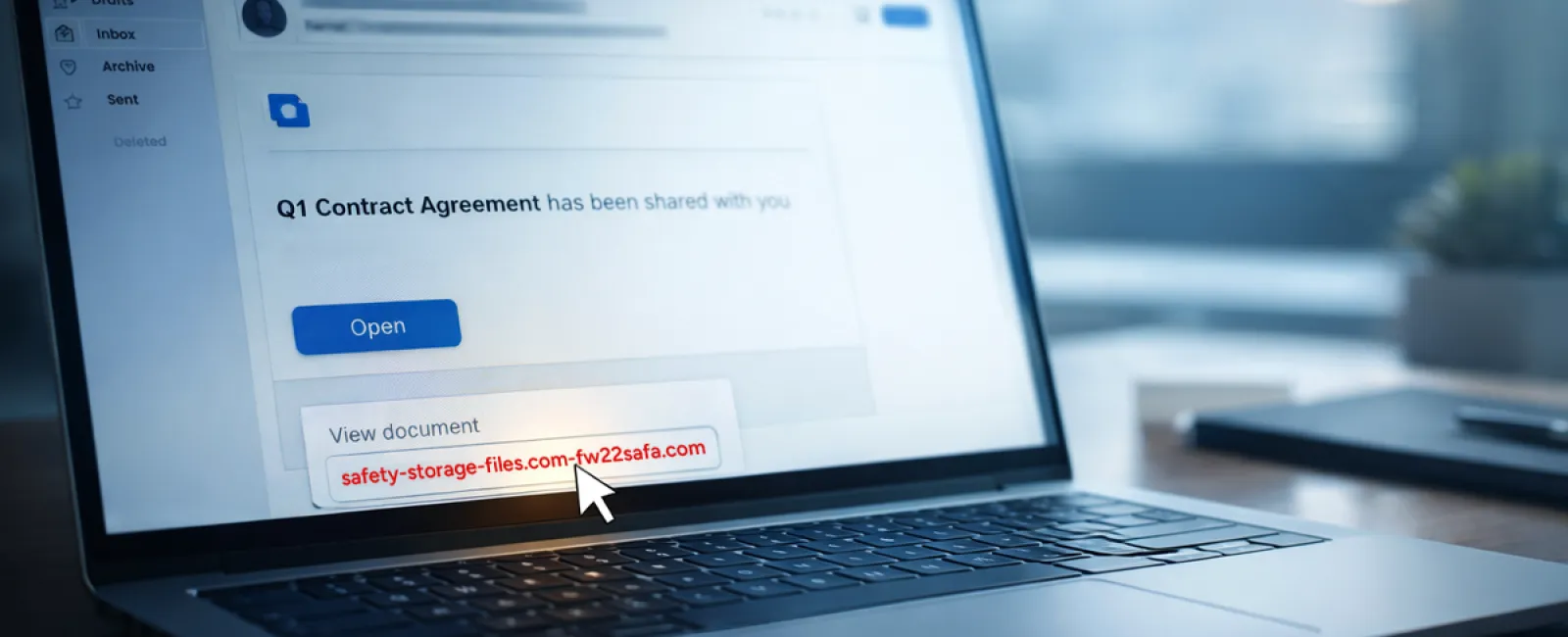
Employees receive emails claiming a document was shared, typically appearing as a contract on DocuSign, a spreadsheet in OneDrive, or a Google Drive file. The sender's name and formatting look authentic.
When clicked, the link prompts a login, capturing credentials and granting attackers access to your company's cloud environment.
Phishing campaigns exploiting trusted platforms like Google Drive, DocuSign, Microsoft, and Salesforce skyrocketed 67% in 2025, per KnowBe4's Threat Labs. Google Slides phishing surged over 200% in six months.
Worse, employees are seven times more likely to fall for these fake files because they mimic legitimate notifications precisely.
Attackers now even use compromised accounts to send sharing notifications from real platforms, bypassing spam filters.
Protect your team: Train employees never to click links in unexpected file-share emails. Instead, they should log into the platform directly to verify shared files. IT can reduce risk by tightening external sharing permissions and enabling alerts for suspicious logins—quick measures yielding big security gains.
Simple caution creates powerful protection.
Scam #3: Sophisticated Phishing Emails
Gone are the days when phishing was easy to spot by poor grammar or odd formatting.
A 2025 study revealed AI-crafted phishing emails achieved a 54% click rate—over four times higher than human-written attacks at 12%—because they look flawlessly legitimate. These emails incorporate real company names, job titles, and workflows harvested instantly from LinkedIn and corporate sites.
Attackers customize messages to departments: HR and payroll receive fake employee verifications; finance teams get payment direction changes. One test showed 72% of employees engaged with vendor impersonation emails, nearly doubling other phishing types. These messages are calm, professional, and urgentreasonable—as if it's just a routine day.
How to safeguard: Implement a policy where any requests involving credentials, payment updates, or sensitive info must be confirmed via a second method—phone, chat, or in-person. Employees should always hover over email addresses to verify domains and treat urgency itself as a red flag.
True security doesn't rely on panic but on vigilance.
The Core Lesson
These scams exploit familiarity, authority, timing, and the belief that "this will only take a moment."
The real threat isn't careless employees—it's assuming everyone can always pause and choose wisely under pressure.
When one hasty click can disrupt everything, the issue lies in flawed processes—not people.
Best of all, processes are fixable.
How We Can Assist
Most business owners don't want to add another daunting project or become the security trainer for their team.
They just want peace of mind that their business isn't quietly vulnerable.
If you're worried about your team's exposure—or know someone who should be—let's talk.
Book a straightforward discovery call where we will cover:
- Current risks affecting businesses like yours
- Common points where vulnerabilities enter during routine tasks
- Effective ways to lower risk without disrupting workflow
No pressure, no fear tactics—just an open conversation to uncover concerns and explore solutions.
Click here or give us a call at 1300 765 014 to schedule your free 15-Minute Discovery Call.
If this message isn't relevant to you, please forward it to someone who might benefit. Sometimes recognizing risks turns a "would have clicked" into a "nice try".


